











Whether you’re new to his work or you’ve read several of his titles, our guide will help you decide which Orhan Pamuk books to read first.

The Museum of Innocence
(2008)
Set in Istanbul between 1975 and today, The Museum of Innocence tells the story of Kemal, the son of one of Istanbul’s richest families, and of his obsessive love for a poor and distant relation, the beautiful Fusun, who is a shop-girl in a small boutique.
The novel depicts a panoramic view of life in Istanbul as it chronicles this long, obsessive love affair between Kemal and Fusun; and Pamuk beautifully captures the identity crisis experienced by Istanbul’s upper classes who find themselves caught between traditional and westernised ways of being.

Istanbul: Memories and the City
(2003)
In a surprising and original blend of personal memoir and cultural history, Turkey’s most celebrated novelist, Orhan Pamuk, explores his home of more than fifty years.
What begins as a portrait of the artist as a young man becomes a shimmering evocation, by turns intimate and panoramic, of one of the world’s greatest cities. Beginning in the family apartment building where he was born, and still lives, Pamuk uses his family secrets to show how they were typical of their time and place. He then guides us through Istanbul’s monuments and lost paradises, dilapidated Ottoman villas, back streets and waterways, and he introduces us to the city’s writers, artists and murderers.

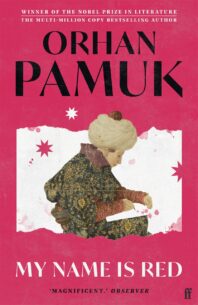
My Name Is Red
(1998)
In the late 1590s, the Sultan secretly commissions a great book: a celebration of his life and his empire, to be illuminated by the best artists of the day – in the European manner. At a time of violent fundamentalism, however, this is a dangerous proposition. Even the illustrious circle of artists is not allowed to know for whom they are working. But when one of the miniaturists is murdered, their master has to seek outside help. Did the dead painter fall victim to professional rivalry, romantic jealousy or religious terror?
With the Sultan demanding an answer within three days, perhaps the clue lies somewhere in the half-finished pictures.

Nights of Plague
(2022)
1901. Night draws in.
With the stealth of a spy vessel, the royal ship Aziziye approaches the famous vistas of Mingheria. ‘An emerald build of pink stone’. The twenty-ninth state of the ailing Ottoman Empire.
The ship carries Princess Pakize, the daughter of a deposed sultan, her doctor husband and the Royal Chemist, Bonkowski Pasha. Each of them holds a separate mission. Not all of them will survive the weeks ahead. Because Mingheria is on the cusp of catastrophe. There are rumours of plague – rumours some in power will try to suppress.
But plague is not the only killer.
Soon, the eyes of the world will turn to this ancient island, where the future of a fragile empire is at stake, in an epic and playful mystery of passion, fear, scandal and murder, from one of history’s master storytellers.

Snow
(2002)
The year is 1992. Ka, a poet and political exile, returns to Turkey as a journalist, assigned to write an investigative piece about troubling events in the small and mysterious city of Kars near the Armenian border.
The snow is falling fast as Ka arrives, and soon all roads are closed. He discovers a city plagued by a ‘suicide epidemic’ amongst young women and where the Islamists are poised to win the municipal elections. If he wants to understand what’s happened to this part of the world during his absence, this is the place to begin.
But the rogue coup that unfolds before his eyes over the next three days tells him far more than he wants to know. He sees a city wasting away under the shadow of Europe, consumed by religious and political conspiracies and haunted by the silences of its own history.
Silent House
(1983)
As the political tension from Turkey’s tumultuous struggle for modernity builds, an old widow Fatma waits with her faithful servant Recep for her grandchildren to descend for their annual visit: Faruk, a failed historian; his sensitive leftist sister, Nilgun; and Metin, a high school student who lives the fast life of the nouveaux riches while dreaming of escape.
The arrival of Recep’s nephew Hassan, who has recently fallen in with right-wing extremists, draws the family into the growing political cataclysm. As the country wavers towards tragedy, the family is forced to confront their past and decide where they stand.
The Black Book
(1990)
Galip’s wife has disappeared. Could she have left him for Celál, a popular newspaper columnist? But Celál, too, seems to have vanished.
As Galip investigates, he gradually assumes the enviable Celál’s identity, wearing his clothes, answering his phone calls, even writing his columns. But despite pursuing every clue, the nature of the mystery keeps changing, and Galip never feels himself to be any closer to finding his beloved Ruya. When he receives a death threat, he begins to fear the worst . . .
The White Castle
(1985)
A young Italian scholar is captured by pirates between Venice and Naples. After being put up for auction at the Istanbul slave market, he is bought by a Turkish savant eager to learn about scientific and intellectual advances in the West.
But as master and slave bond over each other’s sins and secrets, their relationship grows increasingly complex. They soon find themselves part of the Sultan’s army and on a journey that will lead them to the mythical White Castle.
The New Life
(1994)
Osman is a young engineering student when he finds a mysterious and dangerous book that promises him a new and exciting life. He abandons his studies, turns his back on home and family, falls in love and embarks on restless bus rides through a nocturnal landscape of travellers’ cafes and apocalyptic bus wrecks, all in pursuit of this elusive vision.
But will he, or the reader, ever understand the nature of this strange obsession?
The Naive and the Sentimental Novelist
(2010)
What happens within us when we read a novel? And how does a writer create its unique effects? In this thoughtful and deeply personal book, Orhan Pamuk takes us into the worlds of the writer and reader, revealing their intimate connections.
How is it that novels conjure landscapes so vivid they can make the here and now fade away and characters so complex we feel we know them beyond the page? With Tolstoy, Dostoevsky, Stendhal, Flaubert and Proust as companions, Pamuk considers the ‘sweet illusion’ of the fictional world and the hold it exerts upon us. Anyone who has known the pleasure of becoming immersed in a novel will enjoy, and learn from, this perceptive and enchanting book.
The Red-Haired Woman
(2016)
A studious young man spends a summer helping a master well-digger search for water on a barren plain.
As the two struggle in the summer heat, they develop a filial bond neither has known before. In the nearby town where they spend their evenings, a travelling theatre group has come to stay. The young man is fascinated by the Red-Haired Woman, an alluring member of the troupe, and their brief but intense love affair drives everything else from his mind.
But in his distraction, a horrible accident occurs, which will haunt him for thirty years. Until he decides to track down the Red-Haired Woman and finally understand the fallout from that unforgettable summer . . .
A Strangeness in My Mind
(2014)
As a child, Mevlut always felt like he was missing out. When he moves to Istanbul – ‘the centre of the world’ – he is immediately enthralled. He wanders through its alleys for forty years, working as a street vendor and gaining a unique perspective of a radically changing city.
Mevlut watches his friends and relatives settle down and make their fortunes, while he stumbles toward middle age in a series of jobs leading nowhere. He never manages to shake the ‘strangeness in his mind’, until at last fortune conspires to let him understand what it is he yearns for . . .
Other Colours
(1999)
Reflections on his successful struggle to quit smoking, his anxiety at testifying in court, his first trip to Europe and his father’s death are accompanied by Pamuk’s own black-and-white drawings. By turns witty, moving, playful and provocative, Other Colours glows with the energy of a master at work.
This article was first published in July 2022. New editions of The Museum of Innocence, Istanbul, My Name is Red, Snow: A Novel and Nights of Plague are available now.
About the Author
Orhan Pamuk is the author of many celebrated books of fiction, nonfiction, and photography. In 2003 he won the IMPAC prize for My Name is Red, and in 2006 he was awarded the Nobel Prize in Literature.
Read MoreAbout the Author