










The World of Wes Anderson: Exhibition, Films, Books & Screenplays
In this article:
If you would like more arts content straight to your inbox, join Faber Members (it’s free) to receive our weekly newsletter. Use code Members10 for ten per cent off your first order.
‘No Crying’ reads the text above the entrance to the Wes Anderson exhibition at the Design Museum.
To some, this may seem a signal that we are about to enter a pantheon of whimsy – an Andersonian affectation – but diehard fans will recognise it from the mantra printed over Arthur Howitzer Jr.’s office door in 2021’s The French Dispatch. Either way, it suitably sets the tone for the carefully curated world we’re about to step inside.

The first objects we’re greeted by are a display of Anderson’s notebooks – rows and rows of mustard-yellow, spiral-bound pads, starkly utilitarian and unassuming, each differentiated only by the name of the film they relate to.
Some are thrown open, others show hand-drawn storyboards within. For most of us, this is the first time we’ll have seen the auteur’s neat, boxy handwriting, and it’s somehow exactly as you’d expect (precise, a bit quirky). From the start, the exhibition is clear: here is a film-maker who plans out every detail.
Above the glass display are polaroids from film sets; well-known actors from Anderson’s films are photographed in casual camaraderie behind the scenes. Here, Bill Murray caught by surprise, there, Owen Wilson laughing in full costume. This juxtaposition of polaroids next to notebooks is notable: from the offset we’re primed for the notion that despite all the planning and control, this show is also about collaboration.
From this point I begin my journey through a chronological maze that chronicles each of the auteur’s films, from Bottle Rocket (1996) right up to The Phoenician Scheme (2025).
The walls are painted a deep crimson – the particular shade signed off by Wes himself, of course. Red is not the colour one might immediately expect as the backdrop to the pastel-soaked sets of Anderson’s movies, but it does well to set the objects in sharp relief, and it undercuts any accusations of twee. Cutouts in the display create windows from one film to another, and though this is likely a strategy for lighting, you also can’t help but think about the evolution of creative work: each film informed by what came before and gesturing towards what is yet to come.

There are over 700 items on show here, spanning three decades of film-making, and it’s the first time Anderson’s archives have gone on display in the UK.
There are standouts, of course: the vending machines from 2023’s Asteroid City loom large and the model for the Grand Budapest Hotel, used to capture the building’s facade for the titular film (2014), is a striking sight at over 3 metres tall, walls drenched in a candy-pink gradient. But, for me, it’s Margot Tenenbaum’s fur coat that jumps out as a personal highlight: how many Halloween or fancy dress parties have each of us been to where someone is dressed as Gwyneth Paltrow’s iconic character from The Royal Tenenbaums (2001), eyes outlined in black kohl and bob straightened to whimsical perfection?


At the glass cabinet of puppets from Fantastic Mr. Fox, a woman defies the one rule we were presented with: she is in floods of tears, being comforted by a friend, overcome by the miniatures before her.
Mr Fox gazes blankly forwards in his corduroy jacket, unperturbed. Filmic worlds are by nature conceptual, intangible. So to be confronted with the materiality of these objects is, unsurprisingly, disarming for some. Objects are not merely objects in Wes’s world; they are often emotional signifiers and become cultural touchstones.
While the exhibition highlights the detail and precision underlining Anderson’s worlds, it also takes care to nod towards the collaboration that makes this possible. Creativity is celebrated at every turn. For instance, in the Moonrise Kingdom section of the exhibit, we learn that twelve-year-old painters were auditioned to create a handful of pictures drawn by the child characters in the film. There is primacy given in particular to the handmade, which stands out in an era of generated digital content. Even the animated films in Anderson’s oeuvre eschew the computer-generated, favouring stop-motion puppets in real miniature sets. It makes for an incredibly tactile world. Pure whimsy it is not.
I leave the exhibition the way I came in. I skip the short films screening behind a curtain (Hotel Chevalier, The Swan and others) – most I’ve already seen, and I don’t want to lose this feeling I have.
This is an exhibition of things. And things are often derided or misunderstood: our capitalist, consumerist world has melted things down to something to be consumed rather than something that is. But this entire exhibition, for me, makes an argument for craft and collaboration over mere content. I’m buoyed by the feeling of slow art and the material culture represented here. It’s as if there’s a quiet, ideological charge at play, if not by design then by its very existence in our current climate. How we make things matters as much as what we make.
As I return to the soggy London streets and rejoin the commuter class, I feel as if I’ve unlocked something else within Anderson’s work. Some argue his films can seem cold for all their precision, holding you at arm’s length with their careful symmetry and deadpan delivery. Yet after this exhibition, with its foregrounding of craft, collaboration and sheer dedication to art, I feel differently. To me, now, his films have never felt more human.


Our Favourite Wes Anderson Films
We asked Faber staff for their favourite Wes Anderson movies. Here are their recommendations.
Rushmore. I love Rushmore. For all his naivety, Max Fischer is the prototype Anderson hero: totally determined to shape the world to how he sees it. Even the feud he wages with Bill Murray’s industrialist – featuring bee swarms! booby-trapped car brakes! – feels oddly noble. An acting out of how things ought to be. And Max’s tenderness will break your heart. What could be sweeter, more Wes Anderson, than his attempt to win Miss Cross’s heart for Herman by gifting an idea to his friend?
– Steve King, Head of Content Development
Like many Wes Anderson fans, I love The Grand Budapest Hotel and have seen it more often than any of his films, but my pick is his next film but one, The French Dispatch. I’ve got a bit of a thing for the New Yorker, and the way this film both celebrates and gently parodies this very American institution is brilliant. Anderson cleverly structures the film like a magazine, with a mix of stories told by different writers, and although I could take or leave the first one with Owen Wilson, everything that comes after is solid gold. Even for Wes Anderson, this film is all about the acting ensemble, but at the top of the pile, for me, is a wonderful performance by Benicio del Toro as prisoner–painter–madman. Oh, and some great music on the soundtrack.
– Tim Woodall, Head of DTC Marketing
It’s a tough call, but I think it has to be Moonrise Kingdom. Wes makes the most perfect use of his stellar cast – all the usual incredible ensemble members are there, but Bruce Willis steals the show with his charming, melancholic Captain Sharp. Flood Epic meets zany farce. What’s not to love?
– Kate Ward, Head of Pre-press
My favourite Wes Anderson film is . . . Rushmore. There is probably little doubt that The Royal Tenenbaums and The Grand Budapest Hotel are technically superior films, but, for me, nothing surpasses the sadness and joy of watching as Max Fischer, having somewhat rested on his laurels, having previously saved Latin, starts tilting at windmills in pursuit of impressing an older woman. It lovingly creates echoes of ‘one of the greatest love stories of our time’, Hal Ashby’s Harold and Maude. I also love Moonrise Kingdom for similar reasons.
– Andrew Benbow, Sales Ops & Inventory Executive
The Grand Budapest Hotel. It feels like the culmination of Anderson’s beautiful, weird, generation-defining aesthetic. The performances all sizzle and Tony Revolori is such a natural addition to the Anderson pack. It is tender, funny and thrilling – every bit as delicious as a courtesan au chocolat from Mendl’s bakery.
– Beth Brambling, Online Manager, Faber Academy
I didn’t think I had a clear favourite until recently, when I rewatched The Royal Tenenbaums, and realised that it’s the clear standout for me. I think it’s the first movie where Wes’ signature style really starts to take shape, but the movie overall still retains a solid emotional core – a perfect balance in tone, I think. Beyond that it has great ensemble, Gene Hackman’s last great performance and an incredible soundtrack.
– Lisa Murphy, Senior Marketing Executive
Wes Anderson: The Archives at the Design Museum runs until 26 July 2026.
The screenplay of The Phoenician Scheme, Wes Anderson’s most recent film, is published in paperback on 4 June 2026.
Buy the Book

The screenplay for the 2025 Wes Anderson film.
About the Author
Wes Anderson is the writer/director of Bottle Rocket, Rushmore, The Royal Tenenbaums, The Life Acquatic with Steve Zissou, Darjeeling Limited, Fantastic Mr. Fox and Moonrise Kingdom.
Photo Credit: Roger Do Minh
About the Author

Book Bundle
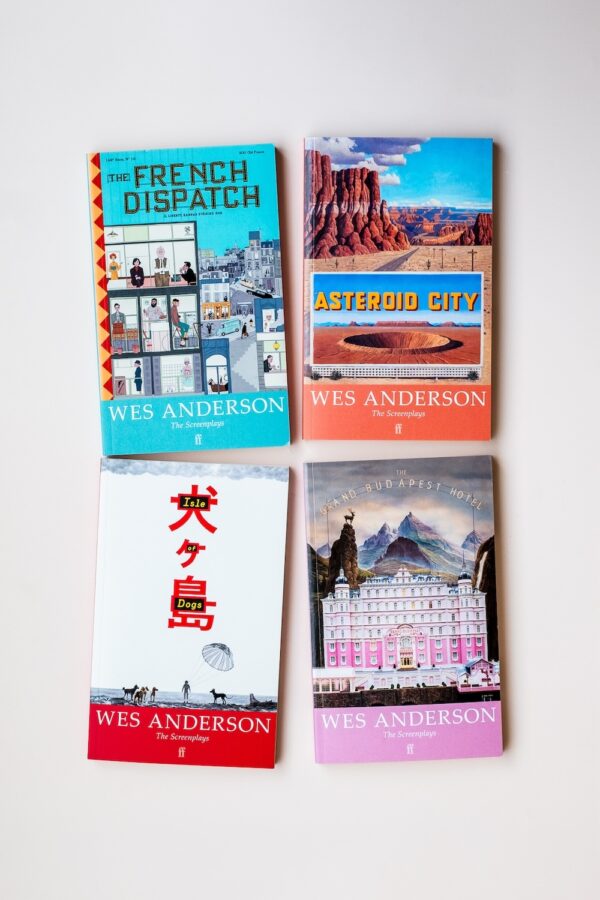
Buy a collection of the four new editions of Wes Anderson screenplays, each book of which includes a gallery of images from the film. RRP value: £51.96.


